The unbearable lightness of flying to sustainability meetings or conferences
There’s a particular kind of absurdity in flying halfway across the globe for a 2-3 days conference or a single day of meetings, especially if the topic is around sustainability. You land, sit in a room talking about green transitions, climate policy, or green guidance, then fly home again – leaving a carbon footprint and a model of behaviour that contradict everything discussed in that room.
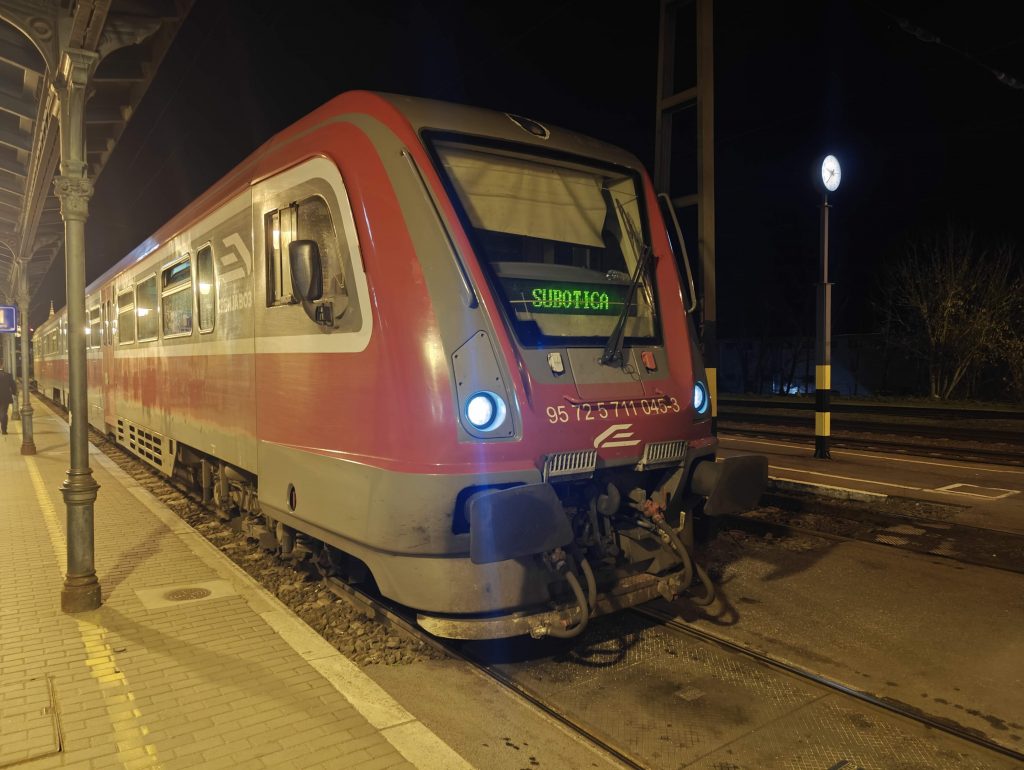
This is a contradiction I’ve been confronted with for a while, especially since working on projects focusing on sustainability. And especially since myself I have been flying a lot in my life. Since a few years I decided to try to limit my flying to the minimum and when a recent partner meeting of the Green deal goes citizens took me toward Subotica, Serbia, I decided to travel by train from Nancy, France, instead of flying. It took a veeeery long time, but it also felt like the only choice that was somehow consistent with the work. Here are some rumblings why this choice makes sense to me.
The impact of air travel and researchers’ role
It’s easy to wave away air travel as a minor factor – “it’s only 2% of emissions,” the argument goes. But according to French environmental outlet Bon Pote, once international flights are counted, aviation’s share of French transport emissions jumps much higher, reaching around 13.7% of transport emissions and 4.4% of the country’s total emissions – and they keep growing fast. Quoting climatologist François-Marie Bréon’s 2019 testimony to the French National Assembly, achieving real emissions reductions “while maintaining air transport, that’s just plain impossible.”
There’s also a deeper issue of social justice – flying tends to be concentrated among wealthier populations, while the people most exposed to climate change’s consequences are largely the ones who rarely, if ever, board a plane. In 2019, 20% of French people had never taken a flight in their lives, worldwide, over 80% of human beings have never been on a flight. Flying is one piece of a much larger picture – a single flight feels small, isolated, almost invisible against the scale of the climate crisis. Multiply that by every project partner or researcher flying to every short meeting or conference across the globe, though, and the arithmetic stops looking small.
The scientific community is very far from being exemplary. The average annual footprint of a European varies (depending of the measurement technique) between 8-11 tonnes CO2eq. While it is difficult to generalize, anecdotal evidence seem seem to suggest it is much higher for researchers:
- A German astronomer’s professional footprint was estimated at 18 tonnes CO2 equivalent per year (Jahnke et al., 2020), more than double the European average.
- A single PhD research project was found to generate 21.5 tonnes CO2e, about two to three times what the average EU citizen emits in an entire year (Achten et al., 2013).
- A benchmark doctoral researcher on a large physics experiment in Germany was found to have an annual professional footprint of 20.56 tonnes CO2e – roughly double the average.
To be fair, there are examples of researchers-driven initiatives that try to limit flying.
Train vs. plane, carbon footprint
In the UK, rail emits 35 grams of CO2 per kilometer compared to 246 grams for a domestic flight, making train travel about 14% of a flight’s footprint. For international rail specifically, the Eurostar emits around 4 grams of CO2 per passenger kilometer versus roughly 154 grams for a short-haul flight. This visual comparison is pretty telling:
For a journey like Nancy to Subotica (approximately 1,322 km return journey), this translates to roughly 28 kg of CO₂ by train versus 390 kg by plane – almost 95% reduction in carbon footprint. Over the course of a year of business travel, choosing trains over short-haul flights could easily save several tons of CO₂ per person.
Beyond individual action
Achieving carbon neutrality by 2050 requires is a drastic reduction of emissions not only in the economy, but in every area of human activity. The goals of the Paris Agreement envisage a decrease in the average carbon footprint of a citizen of the EU from today’s approximately 8-11 tons to 2 tons of CO2 equivalent per year. Research shows that it is illusory to rely on green growth, or the possibility of sufficient and rapid decoupling of economic growth from greenhouse gas emissions. At the current rate of de-carbonisation of the economy and the rate of absolute decoupling, it would take high-income countries 220 years to reach the targets of the Paris Agreement, producing 27 times their fair share of greenhouse gases in the process. Achieving the green transformation thus assumes a huge transformation of the current economic model, as well as significant changes in the lifestyle of every citizen. However, the average emissions hide significant differences within different population groups. Globally, the richest 1% emit more than 75% of the world’s population. The richest 10% emit more than 50% of all greenhouse emissions. At the same time, approximately 16% of the Europeans who live in income poverty already travel less, eat less meat and cannot afford excessive consumption, therefore they bear less responsibility for anthropogenic factors of climate change.
It is therefore important not to put excessive burden on individuals, but to support transformation strategies that try to tackle the complexity of what is widely consider the biggest challenge currently facing the humanity. A profound transformation of our social and economic model is required to respond to this challenge.
So climate change is primarily a societal problem. We need to think about what we can and should do to address this problem. This requires making arbitrary choices about ‘what can continue’, ‘what needs to change, transform’ and ‘what needs to be stopped’. The place we give to air travel in the future will therefore reflect a societal and ethical choice which can be boiled to the following question: Among the changes to be made to achieve a carbon-neutral world, are we prepared to sacrifice a few flight journeys to preserve acceptable living conditions in the decades to come? And don’t @ me with the comments around the “futility of the individual choices“, about “interiorizing the neoliberal individualizing logic“, I know, I know – but if we wait for others to do something, nothing will ever change.
When we choose trains over planes for feasible routes, we’re also demonstrating demand and signal to conference organizers, but also infrastructure planners and policymakers that sustainable alternatives matter. This creates pressure to improve rail connectivity, reduce costs, and increase frequency, all of which make sustainable choices easier for everyone. Also, the importance of ethical consistency and role modeling by researchers working in sustainability seems like a self-evident, low hanging fruit (like not flying from Europe to new Zealand for the IAEVG Conference to talk about green guidance).
The train from Nancy to Subotica won’t be comfortable for everyone, and these “heroic” and seemingly pointless gestures should not give use self-satisfaction or obscure our vision of the political dimension of social and ecological transition. But arriving in Subotica having spent the 2 days watching the landscape change from French vineyards to Hungarian plains to Serbian countryside is itself a reminder of what we’re trying to protect: a world worth traveling.
